

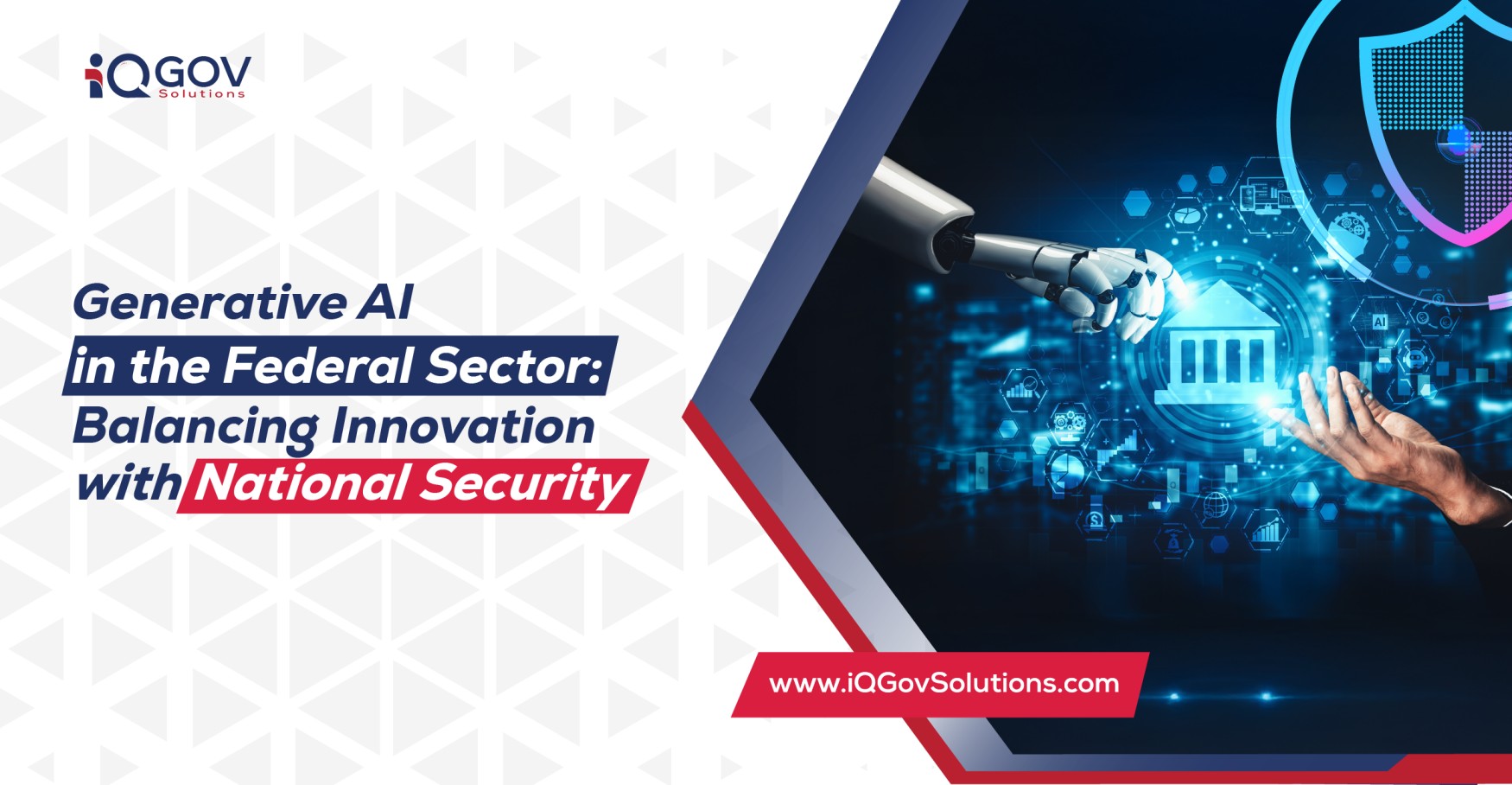
A recent wave of AI deployments is not just a tech trend; it’s reshaping how the federal sector conducts operations, protects citizens, and allocates resources. In February 2026, surveys show a striking reality: 90% of respondents are aware of generative AI tools, and 62% have already used AI for health-related guidance. This juxtaposition of readiness and responsibility underscores the need for a federal approach that prioritizes governance, security, and public trust while enabling thoughtful innovation. For agencies, primes, and government contractors, the question is not whether to adopt generative AI, but how to do so in a way that is secure, transparent, and mission-aligned. In practice, that means emphasizing security-by-design, zero-trust principles, human-in-the-loop accountability, data sovereignty, and workforce readiness.
Below, we examine federal-specific risks, defend a governance-first path, and outline a balanced approach that reconciles innovation with national security.
Federal Context: Risks and Opportunities
The federal section faces distinct challenges as generative AI moves from pilot to mission-critical tool. Risks include handling sensitive data, ensuring data sovereignty, preventing supply-chain vulnerabilities, and maintaining public trust, all while pursuing outcomes that improve efficiency and effectiveness.
- On-demand, secure AI deployments are moving toward on-premises and isolated environments to reduce exposure of sensitive datasets. For example, secure, responsible AI deployments in on-premises and isolated environments illustrate the containment model that federal environments increasingly employ. The core idea is to keep highly sensitive data within trusted boundaries while still gaining AI benefits.
- Centralized platforms for defense and federal workstreams are expanding. The Air Force’s GenAI.mil platform, launched in late 2025, exemplifies a government-facing, approved toolkit designed to accelerate workforce capability while preserving policy controls and security safeguards Air Force Adopts GenAI.mil Platform.
- Policy and oversight are clearly moving from concept to practice. Congressional materials newly published in 2026 emphasize governance, accountability, and the transition of AI into mission-critical infrastructure—a reminder that decisions at the policy level ripple down to procurement, contracting, and program management Congressional witness materials.
Key takeaway: A federal strategy for generative AI must pair risk-aware governance with controlled, secure deployment models that align to mission priorities and statutory protections. See how secure deployments are being framed in the federal context through these recent developments.
Security-by-Design and Zero Trust in Generative AI
Security-by-design and Zero Trust are not add-ons; they are the operating framework for any federal AI implementation. They drive architecture choices, data handling, identity management, and continuous verification across all layers.
- Deployments should begin with threat modeling, encryption by default, and strict access controls, using isolated environments as a default for high-sensitivity workloads. The V2X approach to secure, responsible AI in on-prem and isolated spaces is a practical embodiment of this philosophy V2X secure AI deployment.
- Centralized platforms must integrate security controls from the outset, including supply-chain transparency, model provenance, and auditable decision trails. The GenAI.mil model illustrates how a government platform can embed policy controls, secure data handling, and incident response in a scalable way.
- Key takeaway: A Zero Trust, security-by-design posture reduces risk without stifling innovation, enabling mission teams to work with confidence in controlled environments that meet federal risk management expectations.
Thoughts on implementation (high-level): In the federal context, security is a spectrum rather than a checkbox. Early, practitioner-level security reviews and ongoing red-teaming should accompany any prototype-to-production transition. This ensures that safeguards scale with use cases while protecting data integrity and public trust.
Governance, Policy, and Human-in-the-Loop Accountability
Robust governance and explicit human-in-the-loop processes are essential to maintain accountability, manage risk, and ensure alignment with public-interest obligations.
- Policy frameworks must establish clear authorities for data handling, model usage, and auditability. Congressional materials underscore the importance of oversight and accountability as AI moves toward mission-critical roles Congressional witness materials.
- Human-in-the-loop mechanisms help ensure that AI outputs inform decisions without replacing critical judgment, particularly in high-stakes domains such as health, safety, and national security. Transparent escalation paths and traceable decision records support public trust.
- Public-facing ethics and bias considerations should be codified in policy, including disclosure of AI involvement in outputs, bias mitigation plans, and procedures for redress when automated decisions impact citizens.
- Key takeaway: A federal section of governance must codify who is responsible for AI-enabled outcomes, how accountability is exercised, and how decisions are audited and corrected when necessary.
Thoughts on governance (high-level): The aim is to build a governance spine that aligns agency mission with statutory and regulatory expectations, while enabling flexibility for experimentation under controlled conditions. References to policy-informed practice are evident in recent congressional materials and agency actions Congressional witness materials.
Protection of Sensitive Data, Data Sovereignty, and Ethics
Data protection and sovereignty are non-negotiable in federal AI. Safeguarding citizen data, maintaining jurisdictional control over data, and upholding ethical standards are foundational to public trust.
- Sensitive datasets used for training or inference require rigorous access controls, data minimization, and explicit authorizations, with data localization where required by law or policy. In practice, this means keeping training data within approved boundaries and using federated or on-prem compute where appropriate.
- Ethics and bias mitigation must be embedded by design. Public trust hinges on transparent disclosures about AI usage, bias testing, and outcomes that reflect diverse populations. Contemporary research on AI trust and health care behavior underscores the importance of trust dynamics as AI becomes more embedded in decision-support processes Behavioral Dynamics of AI Trust and Health Care Delays.
- Data governance should include provenance and auditability to support risk management, compliance, and post-incident analysis.
- Key takeaway: Safeguarding sensitive data and ensuring robust data governance are prerequisites for responsible AI adoption in the federal context, reinforcing trust and legal compliance.
The broader technology policy discourse in 2026 emphasizes trustworthy and inclusive AI as foundational infrastructure, aligning with university and policy think-tank perspectives on responsible AI investments University of Pennsylvania Almanac discussion.
Workforce Readiness and Change Management
People, not just platforms, determine the success of a federal AI program. Training, change management, and a culture of responsible adoption are critical to realization of benefits.
- Workforce readiness includes upskilling for data literacy, model governance, risk management, and ethical use. The health care trust study and general awareness data indicate a large portion of the workforce recognizes AI’s relevance, but practical training remains essential to ensure consistent, safe usage across agencies Behavioral Dynamics of AI Trust and Health Care Delays.
- Change management should accompany pilots, with clear success criteria, stakeholder engagement, and transparent communication about risks and mitigations. The experience of centralized platforms like GenAI.mil shows how user readiness and governance can co-evolve with technology.
- Collaboration with industry partners should emphasize capability development, not just procurement, so federal teams can sustain responsible use, maintain governance controls, and adapt to evolving threats and opportunities.
Key takeaway: A successful federal AI program requires deliberate workforce development and change management strategies that align people, processes, and technology with mission objectives.
Conclusion
Generative AI offers meaningful opportunities to improve federal operations, decision quality, and citizen services. But in the federal context, speed must be matched by security, governance, and accountability. A security-by-design, zero-trust approach paired with robust governance, data sovereignty, and workforce readiness forms the cornerstone of responsible adoption. Centralized platforms and on-prem deployments illustrate how large-scale AI can be harnessed without compromising mission integrity, while ongoing policy oversight ensures that AI serves the public interest. If federal agencies and partners pursue a deliberate, risk-aware path, they can realize benefits such as efficiency gains, improved decision support, and enhanced public trust without sacrificing national security.
Explore how iQ GovSolutions governance and risk-management services support outcomes like secure, compliant AI deployments, or get in touch to discuss your scenario.


cialis other names
cialis other names
vidalista 20 mg uses
vidalista 20 mg uses
semaglutid kostenübernahme krankenkasse
semaglutid kostenübernahme krankenkasse
var finns semaglutid naturligt
var finns semaglutid naturligt
cost generic cialis
cost generic cialis
ketoconazole treatment basics
ketoconazole treatment basics
terbinafine nail fungus full overview
terbinafine nail fungus full overview
ivermectin demodex long‑term results
ivermectin demodex long‑term results
ivermectin mechanism expert overview
ivermectin mechanism expert overview
vardenafil 5 mg
vardenafil 5 mg
vardenafil food considerations
vardenafil food considerations
avanafil cost overview
avanafil cost overview
drug insurance coverage
drug insurance coverage
orlistat absorption mechanism
orlistat absorption mechanism
medical review board
medical review board
amoxicillin antibiotic explanation
amoxicillin antibiotic explanation