

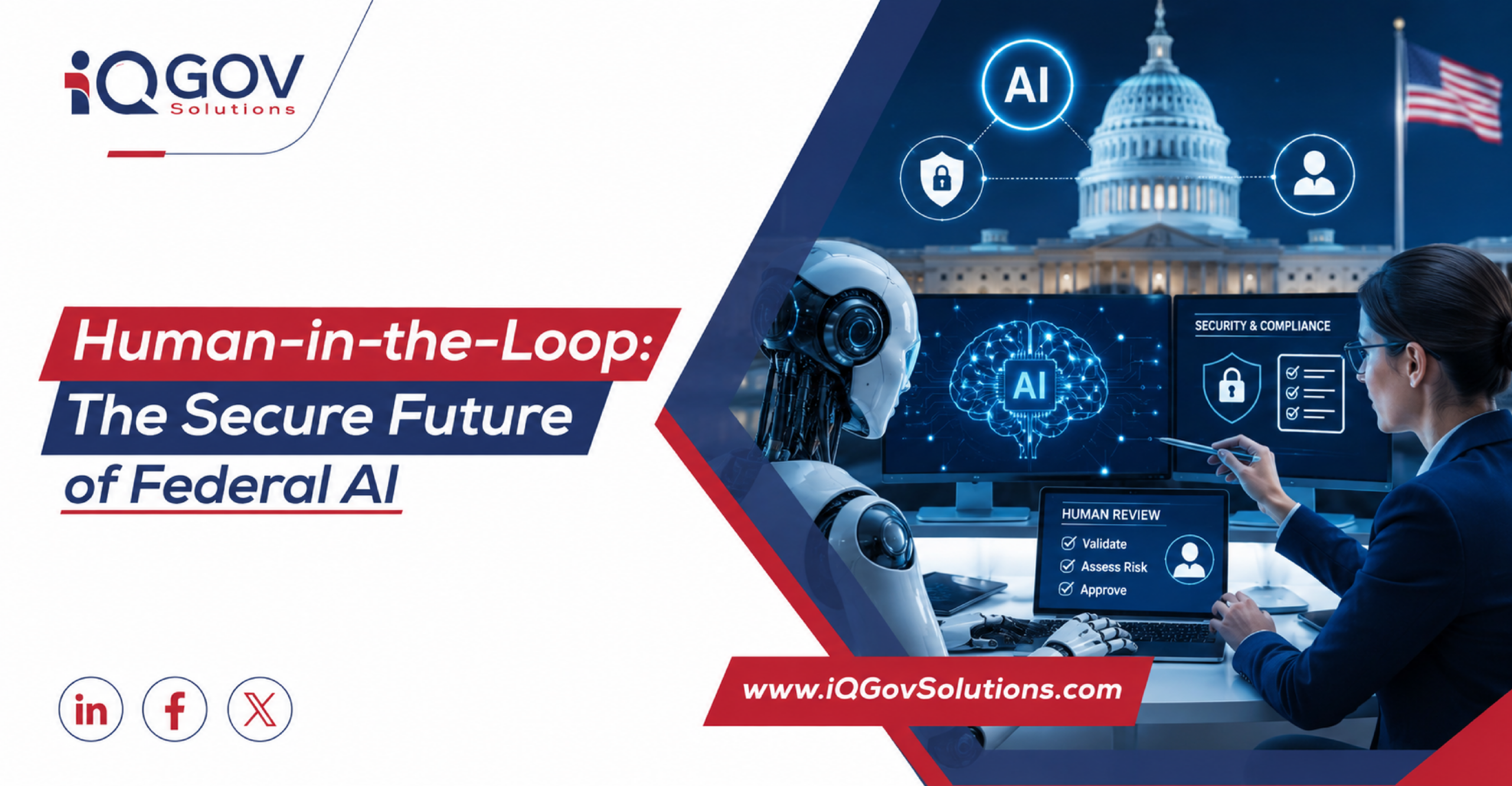
Generative AI has rapidly transitioned from pilot programs to mission-critical workflows across the Federal landscape. While these tools deliver unprecedented speed and scale, they simultaneously expose significant governance, security, and compliance gaps. In the public sector, AI risk isn’t just technical—it is operational, ethical, and strategic.
To build trust, ensure accuracy, and maintain regulatory alignment, agencies must adopt Human-in-the-Loop (HITL) models. When AI outputs inform decisions affecting public life, human oversight is non-negotiable. This approach operationalizes the foundational guidance established by the NIST AI Risk Management Framework (RMF) and the OECD AI Principles.
Generative AI in Federal Operations: Opportunities vs. Risks
Generative AI systems excel at producing text, images, code, or data syntheses in response to prompts. In federal agencies, these tools promise to drastically accelerate policy drafting, case analysis, complex document translation, and data cross-referencing.
However, the same capabilities that enable speed introduce severe liabilities:
- The Hallucination Hazard: Models regularly generate plausible but entirely false content. In a federal setting, this leads to misinformed decisions, erroneous records, and improper public disclosures.
- Data Exposure: Sensitive data used to train or query these models can be misread, misinterpreted, or inadvertently exposed.
- Context Blindness: AI models cannot autonomously encode policy intent, legal nuances, or ethical constraints.
Core Definition: Generative AI vs. Human Judgment
Generative AI is a tool to organize, summarize, and generate candidate outputs. It is not a drop-in replacement for human judgment. The ultimate decision, disclosure, and auditability belong exclusively to cleared professionals and established government processes. This distinction is critical when handling classified or Personally Identifiable Information (PII).
What Makes HITL Essential in a Federal Setting?
Two core mandates make the HITL model a prerequisite for sustainable federal AI adoption:
1. Accuracy and Accountability
AI can rapidly draft documents and propose analyses, but humans ensure that outputs reflect strict intent and context. Decisions must have a traceable chain of responsibility—from data ingestion to model prompting to final human validation—ensuring absolute auditability.
2. Regulatory and Ethical Compliance
Government operations are legally bound by statutes, regulations, and ethics guidelines. HITL aligns with established governance norms by creating transparent decision trails: who approved what, when, why, and how data was handled throughout the lifecycle.
The HITL Implementation Blueprint
Operationalizing HITL across federal agencies and contractors requires disciplined design. A secure, scalable, and resilient deployment must include the following five elements:
1. Define Mandatory Human Intervention Points
Map workflows to identify regulatory or mission-critical thresholds—instances where an AI-generated output could carry legal, safety, or public policy implications. Establish clear criteria for when a human reviewer must intervene, what constitutes an acceptable output, and how exceptions are documented.
2. Enforce Robust Data Governance
Classify data by sensitivity, apply least-privilege access controls, and enforce data handling rules to prevent leakage. Maintain strict data provenance and lineage: you must be able to prove the origin of inputs, how outputs were generated, and which professional approved them.
3. Pair AI with a Credentialed, Distributed Workforce
Design for human oversight to scale alongside data loads without bottlenecks. This is achieved by pairing AI workstreams with a vetted, credentialed, and distributed workforce. Utilizing trusted professionals ensures that essential domain knowledge bridges the gap between rapid AI generation and mission-aligned decision-making.
4. Require Auditable, Explainable Outputs
Every AI-generated artifact must include a concise rationale or justification for its suitability, along with flags for potential bias or data gaps. In federal programs, explainability is a hard requirement for a defensible security posture.
5. Pilot, Measure, and Scale
Start with controlled pilots to test HITL workflows against predefined success criteria (tracking accuracy, turnaround time, risk exposure, and user satisfaction). As you scale, maintain rigorous vendor due diligence, ongoing security assessments, and clear lines of authority for model updates.
Inside a Scalable HITL Workflow
[Data Intake & Classification] ➡️ [AI Generates Prototyped Output] ➡️ [Routed to Cleared Domain Expert] ➡️ [Reviewer Validates/Edits/Rejects] ➡️ [Final Action & Auditable Log Entry]
In practice, a scalable workflow functions as a continuous compliance loop. System logs must capture the exact model version, the prompts used, the data sources referenced, and the reviewer notes. This comprehensive logging enables rigorous post-incident analysis and smooth governance reviews.
Key Takeaways
- The Validation Anchor: HITL secures Generative AI in federal workflows by grounding autonomous outputs in human validation, accuracy, and accountability.
- Traceable Security: Clear data governance, provenance, and immutable audit trails are mandatory to survive scrutiny from auditors, policymakers, and the public.
- Strategic Scaling: Achieving mission outcomes at speed requires pairing AI efficiency with cleared, domain-expert reviewers who understand policy context.
- Framework Alignment: HITL is the practical implementation of the risk-based controls and transparency mandated by the NIST AI RMF and the OECD AI Principles.
Conclusion: Elevating Governance Beyond the Bot
In high-stakes federal environments, fully autonomous AI is an operational liability. True modernization does not mean removing humans from the equation; it means empowering cleared professionals with AI-driven capabilities under a strict, defensible framework. A Human-in-the-Loop architecture provides the necessary checks, balances, and transparency to ensure that federal data remains secure, decisions remain compliant, and public trust remains uncompromised.
As federal agencies navigate this shifting technological landscape, success depends on partnering with experts who understand the nuances of secure mission delivery. Implementing a resilient, NIST-aligned HITL framework ensures your agency reaps the exponential speed of Generative AI without exposing your operations to unacceptable risk.