

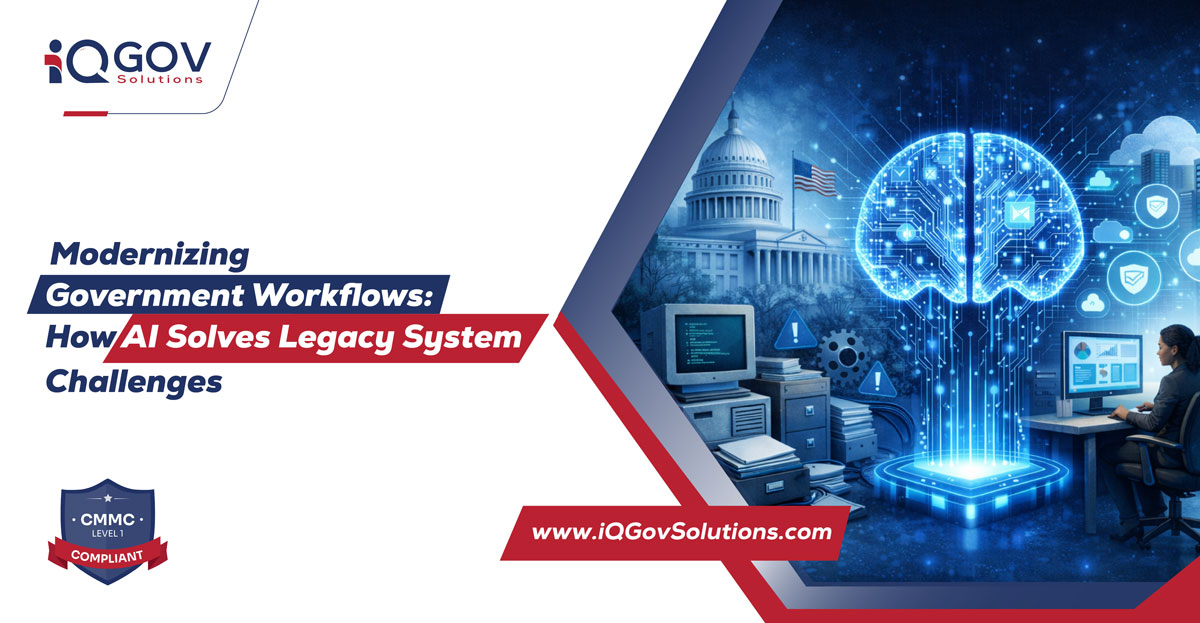
Governments around the world are under increasing pressure to deliver faster, more transparent, and more citizen-centric services—often with limited budgets and aging infrastructure. At the heart of this challenge lies a familiar obstacle: legacy systems.
Built decades ago, many government IT systems were designed for stability, not agility. While they once served their purpose well, today they often slow down operations, limit data sharing, and create frustrating experiences for both employees and citizens. Artificial Intelligence (AI) is emerging as a powerful solution, one that modernizes workflows without requiring a risky “rip-and-replace” approach.
For public-sector leaders, the central question is no longer whether artificial intelligence should be adopted, but how it can be introduced responsibly within strict governance, security, and accountability frameworks. While AI adoption in the enterprise sector has accelerated rapidly- driven by measurable gains in efficiency and insight-public institutions face additional obligations around ethics, transparency, and public trust. Observers point to both the rapid growth of AI-driven operational platforms in the private sector and the lessons learned from decades of high-profile government IT failures, where weak governance and unclear ownership undermined even well-funded modernization efforts. Together, these signals make clear that AI can be transformative for government workflows-but only when paired with disciplined strategy and robust architecture.
This blog examines the challenges created by legacy public-sector systems and explains how AI-informed approaches can address them while maintaining safety, ethics, and citizen confidence.
The Legacy System Problem in Government
Legacy systems are deeply embedded in public-sector operations. From tax processing to benefits administration, these systems often suffer from:
- Rigid architectures that are expensive and slow to modify
- Siloed data spread across departments and formats
- Manual, paper-heavy workflows that increase errors and delays
- Limited integration capabilities with modern digital services
Replacing these systems outright can take years, cost millions, and introduce operational risk—making modernization a daunting prospect.
AI as a Bridge, Not a Replacement
Rather than replacing legacy systems, AI can sit on top of existing infrastructure, enhancing functionality and automating processes while preserving core systems of record.
This “augmentation-first” approach allows agencies to modernize incrementally, delivering value quickly and safely.
1. Intelligent Process Automation
AI-powered automation goes beyond traditional rule-based workflows. By combining machine learning, natural language processing (NLP), and robotic process automation (RPA), governments can:
- Automatically process forms, claims, and applications
- Extract data from scanned documents and handwritten records
- Route cases intelligently based on urgency and complexity
This reduces processing times from weeks to days—or even minutes.
2. Unlocking Data Trapped in Legacy Systems
Many government systems contain vast amounts of valuable but underutilized data. AI helps by:
- Normalizing and integrating data across disparate systems
- Identifying patterns and anomalies for fraud detection or compliance
- Enabling real-time reporting and predictive analytics
Instead of static reports, agencies gain actionable insights that improve decision-making.
3. Modern Interfaces Without Backend Disruption
AI-powered chatbots and virtual assistants can act as modern front doors to legacy systems. Citizens and employees can:
- Ask questions in plain language
- Check application statuses without navigating complex portals
- Receive 24/7 support without increasing staff workloads
Behind the scenes, AI translates these interactions into legacy-compatible actions—no major backend overhaul required.
4. Workforce Enablement and Knowledge Retention
Many legacy systems depend on institutional knowledge held by a shrinking workforce. AI helps preserve and scale that expertise by:
- Assisting employees with real-time recommendations
- Automatically documenting processes and decisions
- Reducing onboarding time for new staff
The result is a more resilient and productive public-sector workforce.
Security, Compliance, and Trust
Modern AI solutions are increasingly designed with government requirements in mind:
- Explainable AI supports auditability and transparency
- Privacy-preserving models protect sensitive citizen data
- Human-in-the-loop controls ensure accountability
When implemented responsibly, AI can strengthen—not weaken—public trust.
Practical AI Use Cases in Government
AI applications in government are already delivering tangible results across several domains. In document processing, intelligent OCR and classification technologies accelerate the intake of forms and correspondence, reduce manual data entry, and improve compliance through automated validation and redaction. These capabilities are particularly impactful in benefits administration, licensing, and regulatory submissions.
- Case management systems increasingly use AI to assist with triage and prioritization, ensuring that high-risk or time-sensitive cases receive appropriate attention. Automated task assignment and escalation improve coordination across departments, while detailed audit trails preserve accountability and decision provenance.
- Fraud detection represents another high-value use case. AI-driven anomaly detection and behavioral analytics can surface irregular patterns in benefits claims, procurement, and licensing activities, helping agencies reduce waste and abuse while focusing human investigators on the most credible risks. Continuous monitoring of these models is essential to maintain accuracy and mitigate bias.
- Predictive analytics further extends AI’s value by enabling demand forecasting, workforce planning, and early-warning systems. Agencies can model policy scenarios before rollout, anticipate service surges, and respond more quickly to emerging risks. Meanwhile, AI-enabled chatbots and self-service portals support multilingual access, guide users through complex processes, and deliver consistent information across channel,s improving both efficiency and citizen satisfaction.
The Benefits of AI-enabled Modernization
The benefits of AI-driven government modernization extend beyond efficiency gains. Automation and improved workflows reduce processing times, lower error rates, and allow agencies to redeploy scarce staff resources to higher-impact work. These outcomes mirror broader enterprise adoption trends, while addressing uniquely public-sector constraints.
Transparency and accountability also improve when AI systems are designed with auditability in mind. Explainable recommendations, decision logs, and clear data lineage support internal governance and external scrutiny alike. From a compliance perspective, strong data governance and security controls help agencies navigate increasingly complex regulatory environments for data protection and AI use.
For citizens, the impact is tangible. Faster responses, clearer communication, and more accessible self-service options improve trust and engagement, particularly for underserved or multilingual communities. At the architectural level, AI initiatives often catalyze a shift toward modular, API-driven platforms that scale with demand and adapt to policy change-reducing long-term technical debt rather than compounding it.
Looking Ahead: The Future of AI-driven Public Services
The future of government modernization points toward more integrated, intelligent, and citizen-centered services. Emerging approaches emphasize scalable architectures, explainable models, and governance-informed design capable of supporting increasingly autonomous- or “agentic”- AI capabilities without sacrificing oversight. At the same time, AI regulation continues to evolve across regions, reinforcing the need for adaptable compliance frameworks and proactive risk management.
For public-sector leaders, the path forward is clear but demanding. AI can help governments overcome the limitations of legacy systems and deliver meaningful improvements in service delivery, transparency, and resilience. Achieving that promise requires governance-first thinking, a strong data foundation, and sustained investment in people and processes, not just technology.
Government workflow modernization powered by AI is ultimately about restoring public trust through better outcomes. When done responsibly, it enables faster, fairer, and more accountable services for the citizens who depend on them.
iQ GovSolutions helps federal contractors and DIB small businesses develop CMMC-aligned roadmaps. If you’d like to validate your current posture or align requirements for an upcoming recompete, we invite you to schedule a CMMC readiness discussion tailored to your FY2026 pipeline.


kamagra australia shop
kamagra australia shop
cenforce black viagra
cenforce black viagra
cenforce 100 mg reviews
cenforce 100 mg reviews
cenforce 200 uses
cenforce 200 uses
cyclosporine dry eyes
cyclosporine dry eyes
omeprazole medication classification
omeprazole medication classification
oral semaglutid pris
oral semaglutid pris
ozempic cost
ozempic cost
doxycycline for bronchitis duration
doxycycline for bronchitis duration
sildenafil brand name in bangladesh
sildenafil brand name in bangladesh
acyclovir ointment cream 5
acyclovir ointment cream 5
ivermectin comprehensive guide
ivermectin comprehensive guide
ivermectin rosacea FAQ
ivermectin rosacea FAQ
ivermectin for strongyloides
ivermectin for strongyloides
minoxidil treatment reference
minoxidil treatment reference
sildenafil meal timing effects
sildenafil meal timing effects
ED therapy mechanism
ED therapy mechanism